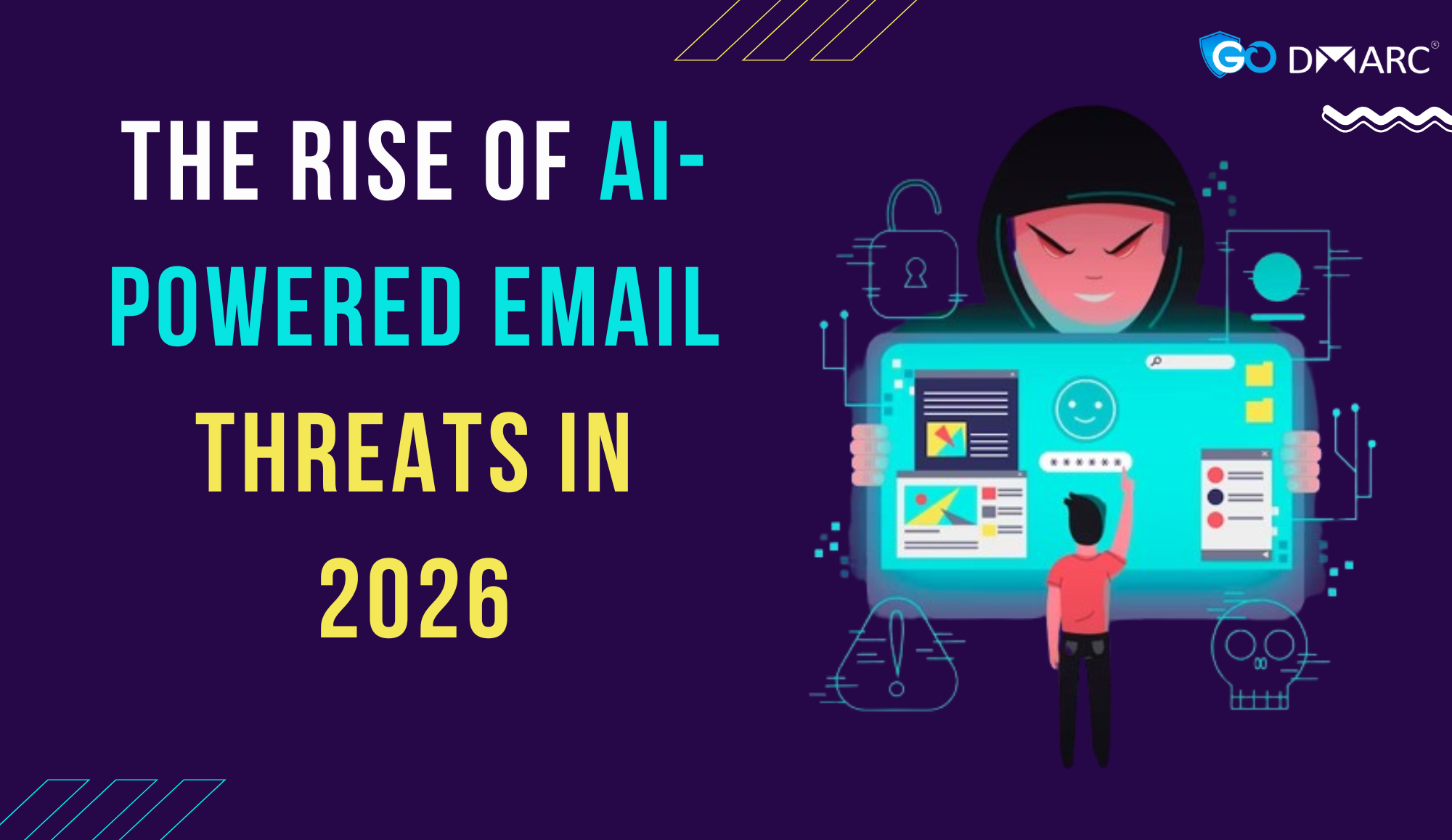
Email has always been the most targeted vector for cyberattacks. But in 2026, the threat landscape has shifted dramatically. Attackers are no longer relying on poorly worded phishing emails or generic spam blasts. They are now armed with artificial intelligence, and the results are devastating.
AI-powered email threats are smarter, faster, and harder to detect than ever before. They mimic trusted senders, craft hyper-personalized lures, and bypass traditional security filters with surgical precision. For businesses that haven’t invested in robust email authentication, the risk is no longer hypothetical; it’s immediate.
This is why protocols like DMARC, SPF, and DKIM have moved from “best practice” to an absolute necessity in 2026.
How AI Has Changed the Email Threat Landscape
For years, cybersecurity teams relied on predictable attack patterns to filter malicious emails. Typos, strange formatting, generic greetings, and suspicious domains were telltale signs. AI has quietly dismantled every one of those indicators.
Today’s AI-powered attacks are capable of:
- Generating flawless phishing content that reads like a genuine message from a colleague, bank, or vendor
- Scraping social media and LinkedIn to craft spear-phishing emails with highly personal context
- Cloning brand voices from public-facing communications to impersonate organizations convincingly
- Automating attack campaigns at a scale that was previously impossible without large criminal teams
- Adapting in real time based on which messages get opened, clicked, or flagged
The result is a new generation of Business Email Compromise (BEC) attacks, invoice fraud, credential harvesting, and executive impersonation, all at machine speed.
The Most Dangerous AI-Powered Email Threats in 2026
1. AI-Generated Spear Phishing
Traditional phishing casts a wide net, hoping someone would bite. Spear phishing has always been more targeted, but AI has made it devastatingly precise. Attackers now feed AI tools with publicly available data, LinkedIn profiles, press releases, email signatures, and social posts to craft messages that feel genuinely personal and contextually accurate.
An employee receiving what appears to be a message from their CEO, referencing a real project, using the right tone, and arriving from what looks like a legitimate domain has very few natural warning signs to catch.
2. Deepfake-Enhanced Email Campaigns
In 2026, email attacks don’t always stop at text. AI-generated audio clips and video snippets are increasingly being embedded into email campaigns or used in tandem with phishing emails to validate fake requests. A CFO who receives an email requesting a wire transfer, followed by what sounds like their CEO’s voice on a quick call, is facing a multi-layered AI-driven attack.
3. AI-Powered Domain Spoofing
Domain spoofing, where attackers send emails that appear to come from your organization’s domain, has been turbocharged by AI. Attackers now use AI to identify organizations with weak or missing email authentication policies and prioritize them as targets. If your domain lacks proper SPF, DKIM, and DMARC records, it is being actively catalogued by automated tools looking for easy impersonation opportunities.
4. Polymorphic Phishing Emails
AI can now generate thousands of unique variations of the same phishing email, each slightly different in wording, structure, and formatting. This polymorphic approach is specifically designed to evade signature-based email filters that rely on detecting known patterns. By the time a filter catches one variant, hundreds of others have already been delivered.
5. Conversational AI Attacks (Multi-Turn Phishing)
Perhaps the most alarming trend of 2026 is the rise of conversational phishing, where AI systems engage in extended back-and-forth email conversations with a target to slowly build trust before delivering the actual malicious payload. These multi-turn attacks are virtually indistinguishable from human communication and can unfold over days or weeks.
Why Email Authentication Is Your First Line of Defense
Against AI-generated content that reads perfectly and attacks that operate at scale, content-based filters alone cannot protect you. The only reliable layer of defense is ensuring that emails claiming to come from your domain actually originate from your domain. That is precisely what email authentication does.
Email authentication does not evaluate whether an email looks suspicious. It validates whether the email is legitimate at the infrastructure level, before a human ever reads it.
The three pillars of email authentication are SPF, DKIM, and DMARC.
SPF, DKIM & DMARC Explained
SPF (Sender Policy Framework)
SPF is a DNS-based record that specifies which mail servers are authorized to send email on behalf of your domain. When an email arrives, the receiving server checks the sender’s IP address against the domain’s SPF record. If the IP isn’t listed as an authorized sender, the email fails the SPF check.
SPF addresses the question: “Did this email come from an authorized server?”
However, SPF alone has limitations. It only checks the server that sent the email, not the domain displayed to the recipient in the “From” header. This is where DKIM comes in.
DKIM (DomainKeys Identified Mail)
DKIM adds a cryptographic digital signature to outgoing emails. This signature is generated using a private key held by the sending organization and verified by the receiving server using a public key published in DNS. If the signature matches, it confirms two things: the email genuinely came from the claimed domain, and the content was not altered in transit.
DKIM addresses the question: “Was this email actually sent by who it claims, and has it been tampered with?”
Together, SPF and DKIM provide strong technical validation — but they still don’t tell you what to do when an email fails these checks. That’s the job of DMARC.
DMARC (Domain-based Message Authentication, Reporting & Conformance)
DMARC is the policy layer that ties SPF and DKIM together and gives domain owners control over what happens to emails that fail authentication. A DMARC policy tells receiving mail servers to either monitor, quarantine, or reject emails that don’t pass authentication checks.
DMARC also introduces alignment — meaning the domain in the “From” header must match the domains authenticated by SPF and DKIM. This is what closes the gap that allows spoofing, even when SPF or DKIM individually pass.
DMARC addresses the question: “What should the receiving server do with emails that fail authentication — and can you report back to me about them?”
The three DMARC policy levels are:
- p=none — Monitor mode. Emails are delivered regardless of authentication results, but reports are sent to the domain owner. Useful for the initial setup phase.
- p=quarantine — Suspicious emails are moved to the spam or junk folder.
- p=reject — Emails that fail DMARC are outright rejected and never delivered. This is the gold standard for protection.
The Relationship Between SPF, DKIM & DMARC
Think of it this way:
- SPF verifies the sending server
- DKIM verifies the message integrity and sender identity
- DMARC enforces a policy based on those results and reports back to you
All three work together. Without DMARC, SPF, and DKIM, results are informational but non-enforced. Without SPF and DKIM, DMARC has nothing to act upon. Deploying all three with DMARC at p=reject closes the door on domain spoofing attacks, even those powered by AI.
DMARC in 2026: No Longer Optional
For a long time, DMARC adoption lagged behind its importance. Many organizations set a p=none policy and never progressed further. In 2026, that approach is no longer acceptable.
Major email providers, including Google and Yahoo, have already mandated DMARC compliance for bulk senders. Regulatory frameworks in multiple regions are beginning to reference email authentication as a baseline security requirement.
Attackers now use automated reconnaissance tools to scan the internet for domains sitting at p=none or with no DMARC record at all. These domains are prioritized targets because they can be spoofed with zero friction. Your lack of a DMARC policy is not just a security gap — it is a visible invitation.
What a Complete Email Authentication Setup Looks Like
Deploying SPF, DKIM, and DMARC is not a one-time configuration task. It requires ongoing visibility, management, and refinement.
Step 1 — Publish an SPF record that lists every service authorized to send email on your behalf (your mail server, marketing tools, CRM, support platforms, etc.).
Step 2 — Enable DKIM signing for all outbound email streams, ensuring each sending source signs messages with your domain’s key.
Step 3 — Deploy DMARC starting at p=none to gather reporting data. DMARC reports (RUA and RUF) give you full visibility into who is sending email using your domain, including legitimate services you may have overlooked and attackers actively abusing it.
Step 4 — Analyze your DMARC reports to identify all legitimate email sources and ensure they are covered by SPF and DKIM alignment.
Step 5 — Advance your DMARC policy from p=none to p=quarantine and ultimately to p=reject once you have confidence that all legitimate sending is authenticated.
Step 6 — Monitor continuously. Your email ecosystem evolves. New vendors, new tools, and new sending sources emerge over time. DMARC monitoring ensures that your authentication posture keeps pace.
How GoDMARC Helps You Stay Protected
Managing SPF, DKIM, and DMARC across a complex organization with multiple domains, dozens of sending sources, and thousands of daily emails requires dedicated tooling. GoDMARC simplifies every step of this process.
With GoDMARC, you can:
- Publish and manage SPF, DKIM, and DMARC records without touching DNS manually
- Visualize DMARC reports in a clear, actionable dashboard that shows exactly who is sending email on your domain
- Detect unauthorized senders and spoofing attempts in real time
- Track your policy progression toward full p=reject enforcement with guided recommendations
- Stay compliant with evolving email sender requirements from Google, Yahoo, and industry standards
As AI-powered attacks grow more sophisticated, the answer isn’t just smarter filters; it’s a verified, authenticated email foundation that makes spoofing your domain technically impossible.
GoDMARC is here to make that journey simple, clear, and complete.